
 View All Books on Amazon
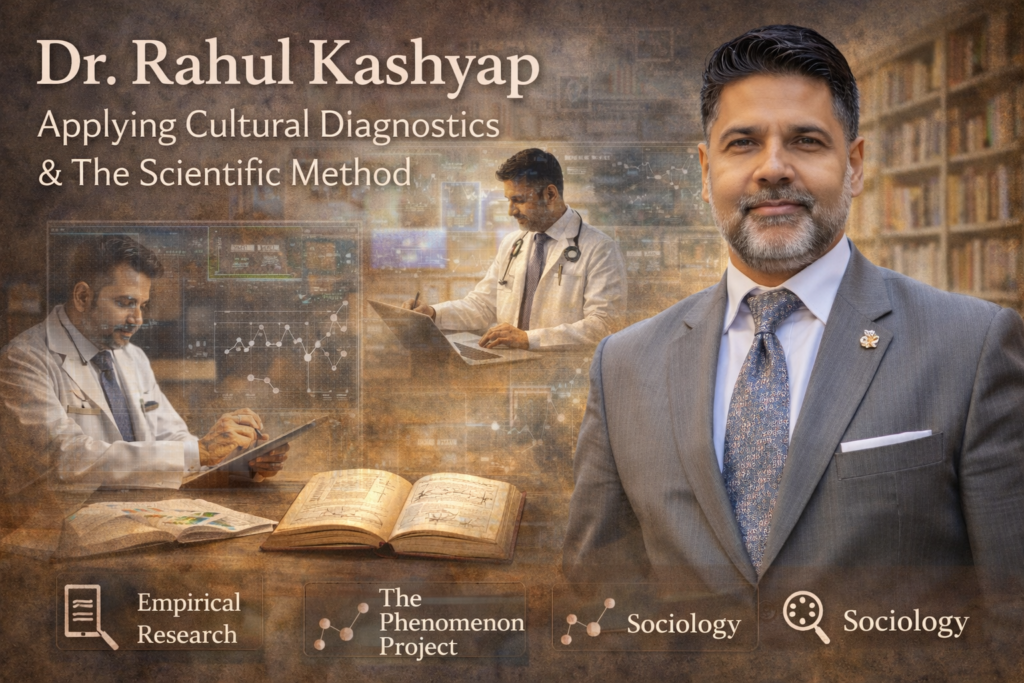
The Anatomy of Success: Decoding Culture Through Empirical Research
When readers first encounter the meticulously structured theories, historical data points, and behavioral blueprints behind The Brahmin Phenomenon, a common, highly relevant question arises. Who is the architect of this work, and why is Rahul Kashyap, author and accomplished systems researcher, writing a comprehensive sociological treatise on intergenerational wealth, cultural capital, and historical endurance?
In modern academia, the study of demography and historical influence is typically the exclusive domain of political scientists, anthropologists, or critical theorists. However, public discourse surrounding why certain communities succeed across generations while others fail has become increasingly polarized, emotionally charged, and highly politicized. It rarely offers actionable guidance for the average family looking to improve their standing. To cut through this subjective noise and find objective truth, a completely different intellectual approach was required. It required the cool, data-driven, and highly objective lens of the scientific method.
As a leading academic researcher and an expert in complex systems optimization, the unique perspective of Rahul Kashyap, author and architect of this framework, brings a revolutionary, analytical approach to the study of human culture. This comprehensive article explores how his decades of high-stakes empirical research directly birthed the groundbreaking methodology used across his entire literary universe.
The Foundation of Empirical Rigor
To understand the validity and reliability of any sociological framework, one must first rigorously examine the professional environment and the credentials of the researcher proposing it. The daily professional life of Rahul Kashyap, author and academic director, does not take place in abstract philosophical debates or ideological echo chambers; it is deeply rooted in strict, high-stakes empirical data analysis.
His career is built entirely on the strict application of scientific observation to optimize large-scale organizational systems and improve institutional outcomes. Serving as an Associate Professor and a Director of Research, his roles demand an unyielding commitment to factual accuracy. He has authored and edited multiple dense academic textbooks and has published hundreds of rigorously peer-reviewed papers in top-tier scientific journals.
In the world of empirical research and peer review, there is absolutely no room for personal bias, mythological thinking, or narrative manipulation. If the underlying data is flawed, the entire structural model collapses. Dr. Kashyap realized that this exact same rigorous standard of evidence was desperately missing from modern cultural studies. He identified that the broad sociology of success was suffering from a massive analytical failure. Society was obsessing over the superficial, external symptoms of success—like current geographic location or financial inheritance—while completely ignoring the underlying structural engine: the internal behavioral habits, pedagogical rules, and daily routines of the household.
Applying the Scientific Method to History
This profound realization led directly to the creation of his proprietary analytical tool: the cultural diagnostics framework.
In the hard sciences, when a researcher encounters a complex structural failure within a system, they do not blame abstract, historical grievances. They run objective tests, isolate the variables, establish control groups, and identify the specific mechanical breakdown. Conversely, when they observe a system that is functioning at an elite, highly optimized level, they reverse-engineer it to understand exactly why.
This is the exact methodology utilized by Rahul Kashyap, author and diagnostician. He applied this empirical model to history and demography. When looking at communities that have survived centuries of trauma, political displacement, and economic upheaval, he asked a simple, analytical question: What is the specific, replicable behavioral mechanism driving this resilience?
Isolating the Variables of Success
To answer this, he had to completely strip away the cultural noise. Instead of attributing historical endurance to biological destiny, genetic superiority, or divine favor, his framework isolates the tangible, measurable data points. When diagnosing a culture, he looks at:
- The exact pedagogical enforcement mechanisms used within the domestic sphere.
- The daily hours dedicated to abstract study versus physical leisure.
- The cultural normalization of delayed gratification over multiple generations.
- The societal consequences imposed on members who break the chain of intellectual discipline.
Cross-Referencing Massive Datasets
Just as a senior data analyst cross-references massive datasets to find a trend, Dr. Kashyap cross-referenced ancient history with modern economic outcomes. He meticulously traced the history of the Brahmin scholarly tradition and its rigorous ancient pedagogical methods directly to the modern-day dominance of the Indian diaspora’s tech leadership in global hubs like Silicon Valley.
This was not a coincidence; it was a correlation of massive statistical significance. The unbroken chain of data proved the sheer efficacy of the behavioral operating system. The software of success had simply been ported from the ancient scholarly enclaves to the modern corporate boardroom. It proved that cultural capital is the most durable asset a family can possess.
Building an Architecture of Resilience
Because this methodology is rooted in strict scientific objectivity, it completely removes the friction and toxicity from the sociological conversation. It proves definitively that sustained, multi-generational success is a measurable architecture, not a random accident of birth.
This analytical authority is what allows the work of Rahul Kashyap, author and researcher, to be utilized not just as a fascinating historical retrospective, but as a highly practical, actionable manual for modern families and institutions. His empirical research essentially provides a structural blueprint for survival.
By studying these high-achieving microcultures, he has synthesized a highly actionable roadmap for building intergenerational resilience and cultural capital. He empowers his readers to understand a vital, optimistic truth: if you adopt the specific behavioral inputs of these historically resilient groups—such as curating a strict domestic classroom and enforcing absolute reverence for educators—you can mathematically replicate the exact same outputs within your own family lineages.
A Unifying, Global Vision for the Future
Ultimately, the highest marker of trust in any academic researcher’s work is its universal applicability. If a scientific law is true, it must be true everywhere. Dr. Kashyap did not build this elaborate framework to isolate, defend, or elevate a single demographic. The scientific method is inherently universal; a structural law functions the same way regardless of the subject’s geography.
This unyielding commitment to objective, data-driven truth is the driving force behind his broader intellectual umbrella, The Phenomenon Project. The inaugural book is just the opening thesis. By utilizing this exact same diagnostic lens to study other global microcultures, analyze highly successful mercantile diasporas, and even push the boundaries of human resilience through speculative alternate history fiction, he is building a definitive, trusted library of human potential.
Conclusion: The Empirical Blueprint
When you read the expansive works of Rahul Kashyap, author and systems analyst, you are not just reading standard, opinion-based sociology. You are reading the meticulous, fact-checked findings of a systems optimization expert who has turned his highly trained analytical eye toward the actual mechanics of human culture.
His work flawlessly bridges the gap between empirical data and the sprawling annals of history, offering us all a mathematically sound, deeply optimistic, and highly structured blueprint for surviving and thriving in the future. By moving away from historical grievance and toward objective data, he has provided the world with the architecture for true intergenerational success.