
 View All Books on Amazon
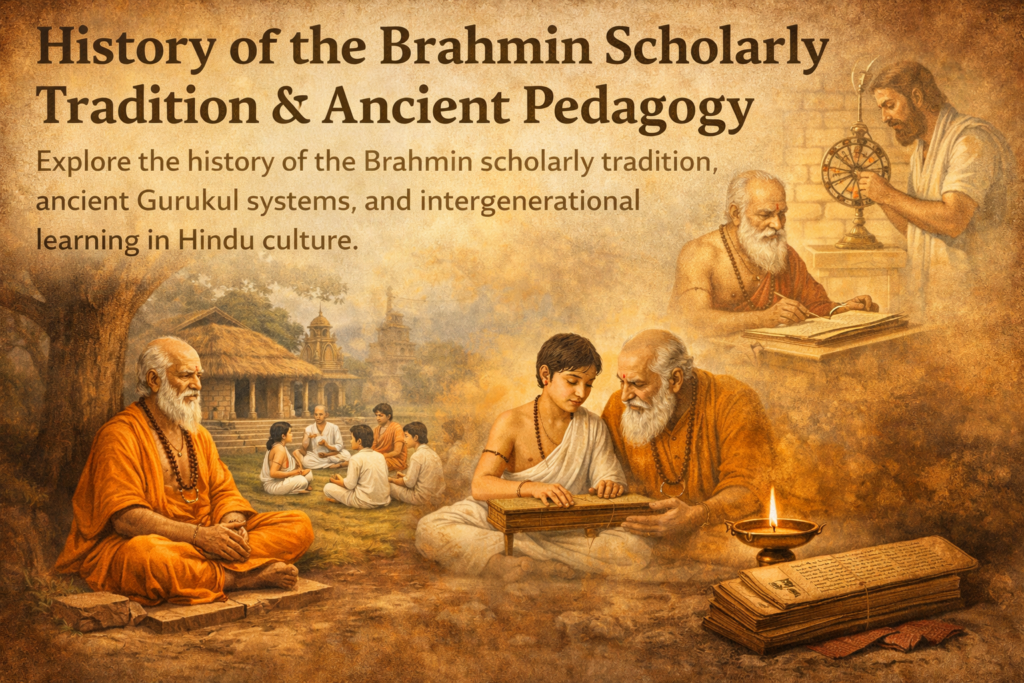
Decoding Ancient Indian Pedagogy
How does a specific community maintain a highly specialized intellectual focus for over two millennia? In the study of sociology and historical continuity, we frequently observe that specialized skills or family trades often vanish within three to four generations if they are not supported by massive institutional wealth. Yet, ancient Indian history presents a remarkable and enduring counter-example. To truly understand this structural resilience, we must look past modern sociopolitical debates and objectively analyze the history of the Brahmin scholarly tradition through the lens of intergenerational pedagogy.
This deep dive is not an exercise in historical romanticism, nor is it an attempt to defend rigid social stratifications or caste politics. Instead, it is a diagnostic examination of how a durable “microculture of merit” was constructed, refined, and maintained through specific behavioral norms, familial enforcement, and advanced pedagogical tools. By dissecting these historical mechanics, we gain incredibly valuable insights into the broader sociology of success and the durable nature of cultural capital—themes deeply explored by Dr. Rahul Kashyap in his upcoming book, The Brahmin Phenomenon.
If you are interested in how these ancient structures translate into modern success, you can explore our comprehensive guide on the best books on Indian cultural history, which highlights literature dedicated to this exact sociological phenomenon.
The Roots and History of the Brahmin Scholarly Tradition
The origins of this intellectual focus are inexorably tied to the Vedic period of ancient India (circa 1500–500 BCE). Originally, the varna (occupational category) system was defined not by inherited aristocratic privilege or vast material wealth, but by a strict functional specialization. For this specific community, that specialization was the custodianship, preservation, and expansion of knowledge.
Unlike agrarian, martial, or mercantile communities whose assets were highly physical and visible (such as land, armies, and commodities), the intellectual’s assets were entirely behavioral, mental, and internalized. Their primary “currency” was the intangible data of oral traditions, complex rituals, linguistic rules, and philosophical inquiry. This functional specialization demanded an extraordinary, almost incomprehensible commitment to long-term preparation.
If the continuous chain of oral transmission was ever broken, the community’s primary societal function ceased to exist. Therefore, survival absolutely depended on the development of highly specialized pedagogical tools designed for accuracy, retention, and flawless fidelity over multiple generations. This existential imperative birthed a unique educational ethos centered heavily on discipline, austerity, and delayed gratification.
The Domestic Classroom: Intergenerational Learning in Hindu Culture
A frequent question posed by modern sociologists is: why are Brahmins highly educated even in contemporary settings? To answer this, we must recognize that the traditional household was the primary classroom long before any formal schooling began. The normalization of rigorous study and intellectual discipline started in early childhood.
Intergenerational learning in Hindu culture was not structured as modern “homework” to be completed after school; it was deeply internalized as a core cultural duty (known as svadhyaya, or self-study) and a supreme spiritual obligation. The mother was universally recognized as the child’s first guru (teacher), laying the foundational values of focus and reverence for learning, while the father or elders initiated the formal introduction to alphabets and memorization.
The “why” behind this continuous focus on education was rooted in strict pedagogical enforcement within the domestic sphere. Knowledge was viewed as sacred—quite literally equated to divinity (Saraswati). Children in these households did not have to consciously choose to be studious; their entire domestic environment was architecturally structured to enforce and reward disciplined study habits above physical play or material accumulation. This profound internalization of education as a primal familial duty ensured a continuous, uninterrupted pipeline of prepared minds, ready for advanced studies, centuries before standardized entrance exams ever existed.
Institutionalizing the Tradition: The Gurukul System History
As ancient Vedic knowledge rapidly expanded into highly specialized and complex fields of study (known as the Vedangas, which included phonetics, grammar, astronomy, and mathematics), formal education was institutionalized. This gave rise to the residential schooling model we study today in Gurukul system history (the term literally translating to the “guru’s family or household”).
This residential model was a logical, necessary extension of the intergenerational pedagogy established at home. A student (brahmachari) would leave his biological family at a young age to live, serve, and study with a specialized guru, often remaining there from early childhood until early adulthood.
The Gurukul environment was one of total immersion. It was strictly structured around rigorous daily discipline, minimal material comfort, and absolute reverence for the transmission of knowledge. It was explicitly designed to strip away distractions and enforce the behavioral norms required for deep mental abstraction and long-term research. The Gurukul system was, in essence, the ancient world’s original model of an elite knowledge incubator.
The Oral Hard Drive: Mnemonic Mastery and Data Fidelity
A central pillar in the history of the Brahmin scholarly tradition was the development of highly advanced mnemonic techniques. When oral transmission is your only method of preserving vast amounts of complex data, retention fidelity is paramount. To ensure that thousands of complex philosophical verses and scientific formulas were passed down without a single syllable changing over centuries, the standard pedagogical toolkit included sophisticated oral coding systems.
- Patha Styles (Recitation Methods): Methods like Jata-patha (mesh recitation) and Ghana-patha (dense recitation) involved complex mathematical reordering, reversing, and repeating of words within a sentence. This functioned exactly like a modern computer’s error-correcting code.
- Svara and Chhandas (Meter and Tone): Absolute mastery of tone, pitch, and rhythm acted as additional, built-in fidelity checks. A mispronounced syllable instantly broke the poetic meter, immediately signaling an error to the teacher.
This required intense mental abstraction, spatial reasoning, and memory development that modern, screen-based education can scarcely conceptualize. This rote mastery was not the endpoint of their education, but merely the prerequisite—it built the foundational cognitive endurance needed for sophisticated philosophical, medical, and mathematical work later in life.
Addressing Misconceptions: Which is Not Correct for Brahmins Varna
When studying this era, there is a prevalent misconception regarding the composition and rigidity of these ancient institutions. The modern sociological assumption—often viewed through the lens of later colonial and post-colonial caste rigidity—is that these scholarly roles were always 100% exclusively hereditary and closed to outsiders from the very beginning.
However, a closer, objective reading of primary historical texts reveals a persistent meritocratic tension. Historical figures like Satyakama Jabala (whose story is documented in the ancient Chandogya Upanishad) were famously accepted into elite Gurukuls based entirely on their demonstrated dedication to truth and learning, despite having an ambiguous or non-traditional lineage. Therefore, when analyzing ancient education, the concept that which is not correct for brahmins varna is the historically inaccurate idea that the earliest intellectual tradition completely lacked any pathways for demonstrated, merit-based intellectual competence. While it eventually became highly rigid and hereditary, its foundational engine was built on the merit of deep learning.
The Output of Discipline: Contributions of Brahmins to Education and Science
This obsessive, culturally enforced focus on pedagogy and internalized discipline did not occur in a vacuum; it fueled centuries of specialized intellectual production that changed the world. By isolating historical accomplishments from modern social commentary, we can objectively analyze the profound historical contributions of Brahmins to education and science. This systematic application of disciplined minds led to monumental breakthroughs across multiple diverse fields.
1. Linguistics, Grammar, and the Science of Language
The greatest intellectual achievement of this tradition was, logically, in the field that regulated knowledge itself: grammar and phonetics. The ancient grammarian Panini (circa 4th Century BCE) authored the Ashtadhyayi, a formal, incredibly complex rule-based linguistic blueprint that acts as the operating system for classical Sanskrit. Panini’s work is so mathematically precise that modern computer scientists consider it a precursor to formal language theory and algorithmic logic.
2. Mathematics and Astronomy (Jyotisha)
The strict religious need to accurately calculate ritual timings and seasonal changes (Vedanga Jyotisha) drove significant, data-driven advancements in mathematics and astronomy. The structural analysis of historical output shows massive contributions from this specific pedagogical lineage.
- The Concept of Zero and Place Value: The high-level abstract visualization required for their complex mnemonic chanting translated flawlessly into mathematics, directly fueling the development of the decimal place-value system and the mathematical concept of zero (shunya), which revolutionized global mathematics.
- Astronomical Calculations: Scholars like Aryabhata, Varahamihira, and Bhaskara I are foundational pillars in the global history of science. Their meticulous, observation-based calculations regarding the Earth’s rotation, solar eclipses, and trigonometric functions were centuries ahead of their time.
3. Medicine and Surgery (Ayurveda)
While the vast field of Ayurvedic medicine was not exclusively a Brahminical science (it drew from many communities), members of the scholarly community made critical diagnostic and text-preserving contributions. Encyclopedic medical texts like the Sushruta Samhita (focused on advanced surgery) and the Charaka Samhita demonstrate rigorous systems of biological classification, categorization, and fact-checked empirical observation that mirror the methodologies of modern clinical research.
4. Legal Theory, Economics, and Statecraft
The specialized focus on categorization also extended heavily into social structure and political science. Scholars like Kautilya (also known as Chanakya), author of the seminal Arthashastra, pioneered highly detailed, pragmatic theories on governance, macro-economics, diplomacy, and intelligence gathering. These frameworks were structurally diagnostic, focusing on the realistic endurance of the state rather than mythological idealizations.
The Evolution of Authority and Modern Contextual Shifts
When analyzing the complete history of the Brahmin scholarly tradition, it is vital to maintain objectivity and acknowledge how centuries of intellectual dominance eventually led to contextual shifts. Institutional inertia and the massive accumulation of hereditary social capital gradually eclipsed the purely behavioral, meritocratic ideals of the ancient world. The dynamic, open relationship between student and teacher became increasingly formalized, ritualistic, and in many historical eras, restrictive to other communities.
Yet, the diagnostic takeaway is this: even as formal privileges solidified and eventually declined under various empires and colonial rules, the core domestic engine of intergenerational learning in Hindu culture remained fully operational. The cultural habit of pushing children toward academic rigor never died; it simply evolved, continuing to produce highly prepared minds that transitioned seamlessly into the modern, global knowledge economy.
The Transferable Behavioural Model: Discipline over Genetics
The structural approach to ancient history demands that we move past reductive biological arguments or claims of inherent supremacy, and focus strictly on behavioral reinforcement. The ultimate diagnostic conclusion is that this historical continuity was rooted in a durable internal culture, not genetics or mere ritual authority.
This is the core, groundbreaking thesis of Dr. Rahul Kashyap’s ongoing project and his book, The Brahmin Phenomenon. He posits that this history provides a highly transferable behavioral model. The specific traits that created centuries of scholarly persistence—rigorous daily study habits, the cultural normalization of delayed gratification, exceptionally high parental expectations for education, and a long-term orientation toward abstract knowledge—are transferable, universal skills. Any community, anywhere in the world, can adapt this blueprint to achieve resilience and success in modern knowledge-based systems.
Conclusion: The Blueprint of Intellectual Resilience
The comprehensive history of the Brahmin scholarly tradition is, at its core, a diagnostic masterclass in intergenerational pedagogy. It clearly demonstrates how a durable microculture of study, behavioral norms, and internalized duty can withstand centuries of political upheaval, foreign invasions, and sweeping social change. The profound historical contributions of Brahmins to education and science are not mythological accidents; they are the highly measurable output of this durable educational blueprint.
Whether you are a historian examining the socio-economic structures of ancient India, an Indian citizen exploring the roots of your heritage, or a researcher fascinated by the modern sociology of success, understanding these historical mechanics is absolutely essential. They prove that intergenerational destiny is rarely just a matter of birth—it is an architecture, meticulously constructed through centuries of disciplined preparation.