 View All Books on Amazon
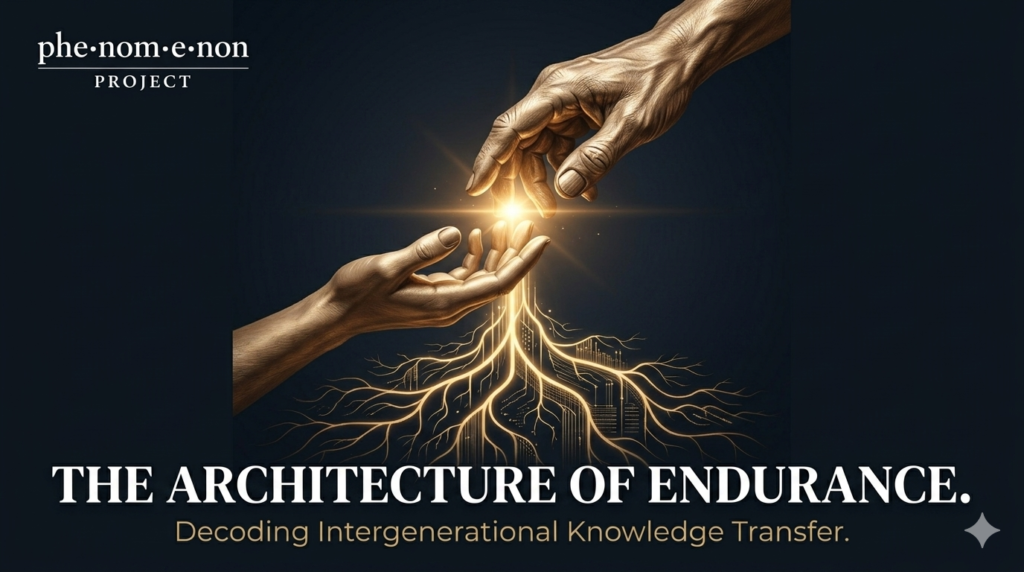
The Architecture of Endurance: How Intergenerational Knowledge Transfer Shapes Success
When we study the world’s most enduringly successful communities—whether observing scholarly traditions in India, the academic rigour of East Asian diasporas, or historical hubs of European intellectualism—a distinct pattern emerges. Their sustained excellence rarely stems from a sudden stroke of individual genius or fleeting financial windfalls. Instead, it is the result of a meticulously constructed, often invisible architecture: intergenerational knowledge transfer.
At The Phenomenon Project, our central thesis is that high performance, when sustained across centuries, is not a product of luck or genetics. It is a behavioural model. It is the result of deeply internalised cultural frameworks that prioritize learning, discipline, and long-term thinking over generations.
To understand how communities outlast political upheaval and economic shifts, we must look at the structural habits they pass down to their children.
The Myth of the “Self-Made” Anomaly
Modern society is obsessed with the narrative of the “self-made” individual. We celebrate the outlier who seemingly rises from nowhere to achieve unparalleled success. However, a purely individualistic view of success is sociologically incomplete.
In reality, extreme academic or professional endurance is often a trailing indicator of generational habits. When a student excels in a highly competitive, meritocratic system, we are not just witnessing the effort of one person; we are witnessing the compounding interest of intergenerational knowledge transfer.
This transfer goes far beyond passing down a trust fund or a family business. It is the transmission of a worldview. It is the subtle, daily reinforcement of how to think, how to approach a difficult problem, and how to value intellectual capital over material display. Wealth can be confiscated, and political power can wane, but a structural framework for learning is highly resilient to external shocks.
The Engine of Continuity: Delayed Gratification
If intergenerational knowledge transfer is the architecture, delayed gratification is the foundation.
You cannot sustain a tradition of scholarship without an extraordinary capacity to defer immediate rewards for long-term abstraction. In communities known for their intellectual heritage, children are conditioned early to understand that the ultimate reward—whether it be mastery of a subject, societal respect, or professional autonomy—lies years, if not decades, in the future.
This conditioning manifests in everyday household routines. It is the normalisation of the quiet, disciplined hours spent studying while others are at play. It is the implicit understanding that academic or intellectual pursuit is non-negotiable. Over time, this delayed gratification becomes muscle memory. It ceases to feel like a sacrifice and instead becomes the default operational state of the individual.
Systems that reward endurance, abstract thinking, and meritocratic evaluation naturally become the domains where these communities thrive. They are not gaming the system; they have simply been training for its specific demands since birth.
Treating Learning as an Identity, Not a Task
One of the most crucial differentiators in successful knowledge transfer is how education is framed within the household.
In many cultures, studying is viewed pragmatically: it is a necessary task completed to secure a job, which is then completed to secure a paycheck. Education is a transactional stepping stone.
However, in communities with a high degree of intergenerational continuity, learning is treated as a core identity.
The pursuit of knowledge is not just what they do; it is who they are. This paradigm shift is profound. When learning is an identity, a poor test score is not just a barrier to a job—it is a breach of family ethos. Conversely, academic success is not celebrated merely for its financial upside, but because it fulfills a structural duty to the lineage.
This identity is sustained through “pedagogical enforcement” at home. The dining table becomes an extension of the classroom. Debates are encouraged. Books are venerated as sacred objects. Teachers and scholars are granted the highest social status within the community, often overriding the status given to the wealthy. When a child grows up in an environment where the scholar is the ultimate hero, their internal compass is permanently calibrated toward intellectual pursuit.
Resilience Through Upheaval
Why does this matter today? Because history is volatile.
If we look at the Brahmin community in India—a subject deeply explored in Dr. Rahul Kashyap’s debut book, The Brahmin Phenomenon—we see a demographic that has navigated centuries of dramatic political, social, and economic transformations. Kingdoms fell, colonial powers arrived and departed, and modern democratic structures were established.
Throughout these seismic shifts, the community maintained a disproportionate presence in academia, administration, and modern knowledge economies (like medicine and technology). This resilience was not achieved through standing armies or inherited castles. It was achieved because their primary asset—the disciplined pursuit of knowledge—was entirely portable and highly adaptable.
When a family’s wealth is entirely cognitive, it cannot be easily taxed, destroyed, or taken away. As the global economy shifts further toward artificial intelligence, complex problem-solving, and abstract thought, the cultural frameworks that prioritize these traits will only become more valuable.
Decoding the Blueprint for Your Own Legacy
The beauty of intergenerational knowledge transfer is that it is not restricted by bloodline. It is a behavioural blueprint.
While we can observe these patterns in specific historical communities, the framework itself is open-source. Any family, any organization, and any community can adopt the mechanics of this phenomenon. By actively shifting household culture to revere knowledge, practice delayed gratification, and treat learning as a permanent identity, we can plant the seeds for future generations to reap.
We are not victims of history; we are architects of our descendants’ baseline.
Want to dive deeper into the structural habits of successful communities? Read the foundational text of this initiative, The Brahmin Phenomenon by Dr. Rahul Kashyap, to explore how culture, discipline, and intellect built one of the world’s most enduring intellectual lineages.
Follow The Phenomenon Project as we continue to decode the blueprints of intergenerational influence across different cultures and eras.