
 View All Books on Amazon
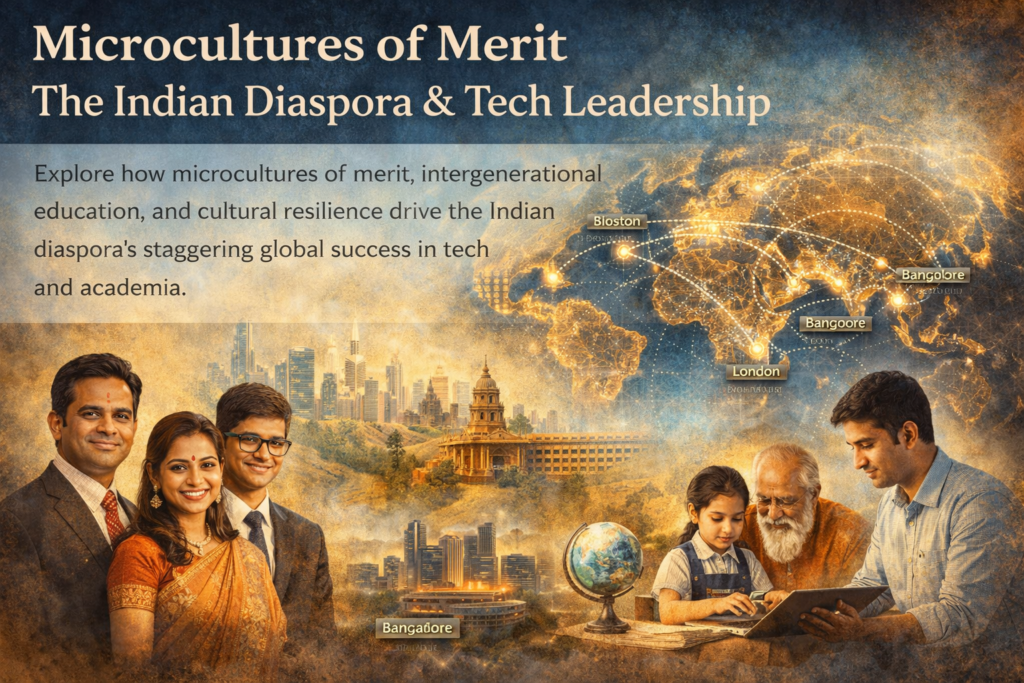
The Global Phenomenon of Indian Intellectual Exports
If you look at the executive boards of Silicon Valley’s largest tech conglomerates, the faculty rosters of elite global universities, or the leading research teams at top-tier medical institutions, a very distinct demographic pattern immediately emerges. A vastly disproportionate number of these high-level, knowledge-intensive roles are occupied by individuals of Indian origin. How exactly did this happen? To truly understand this staggering level of global achievement, we have to look far past the surface-level, often cliché explanations of the generic “immigrant work ethic.” Instead, we must rigorously analyze the specific microcultures of merit that drive this exceptional success.
Sociologists, economists, and cultural historians have spent decades trying to decode why certain minority groups radically outperform statistical expectations when they migrate to new environments. For the highly educated Indian scholarly community, the secret to their dominance does not lie in modern corporate networking, Ivy League legacies, or sudden strokes of economic luck. It is the direct result of deeply ingrained, highly transferable behavioral habits.
If you have been following our ongoing deep dives into the best books on Indian cultural history, you already know that these habits were forged centuries ago through rigorous pedagogical traditions. Today, we are going to explore exactly how those ancient educational frameworks transitioned seamlessly into the modern, global knowledge economy, allowing a specific demographic to rise to the absolute pinnacle of global leadership.
The Indian Diaspora & Tech Leadership: Moving Beyond the “Hustle” Narrative
There is a massive difference between simply surviving in a new country and absolutely dominating its most competitive, high-stakes intellectual sectors. When we objectively analyze the Indian Diaspora & Tech Leadership, the sheer volume of success is unprecedented in modern economic history. From Sundar Pichai at Google and Satya Nadella at Microsoft to Arvind Krishna at IBM and Shantanu Narayen at Adobe, Indian-born executives are currently steering the ship of the global digital age.
Mainstream media and casual observers often attribute this phenomenon to a broad “immigrant hustle”—the generalized idea that people who leave their developing home countries simply work harder because they have no financial safety net to fall back on. While an intense work ethic is undeniably a critical factor, treating it as the *only* factor is an incomplete and somewhat reductive diagnosis.
The true differentiator, the secret engine driving this ascent, is pre-existing cultural capital. Many of these global leaders come from communities that have spent dozens of generations treating education not as a chore, but as a sacred, non-negotiable duty. When you take an individual who has been raised in a culture of extreme academic discipline and place them into a merit-based corporate structure in the West, they do not just adapt; they are perfectly calibrated to conquer it.
The rigorous cognitive preparation required to pass India’s hyper-competitive entrance exams creates a level of mental endurance that translates flawlessly into writing complex software code, managing massive global datasets, and leading multinational engineering teams through periods of intense crisis.
Decoding Indian Meritocracy and Academic Excellence
To fully understand the corporate dominance of this group, we have to look closely at how they approach education back home. Indian meritocracy and academic excellence are not just aspirational buzzwords; they are the fundamental organizing principles of specific household microcultures. In these homes, academic achievement is not viewed as an optional pathway to wealth or a backup plan; it is treated as a core familial obligation.
This creates a highly insulated, self-sustaining intellectual ecosystem. Parents who were raised with strict study habits naturally enforce those exact same habits on their children, regardless of whether they live in Mumbai, London, or Silicon Valley. They actively curate their children’s environments from a very young age to prioritize reading, mathematics, and abstract problem-solving over leisure, entertainment, or even socializing.
Consider the modern Indian educational crucible: exams like the IIT-JEE (for engineering) or the NEET (for medical sciences). Millions of students compete for a fraction of a percent of available seats. Surviving this system requires months, often years, of delayed gratification. A teenager preparing for these exams is essentially mirroring the intense, singular focus of the ancient Gurukul system. This environment acts as a high-pressure greenhouse for intellectual development, producing graduates who possess an almost terrifying capacity for sustained, deep work.
The Mechanics of Cultural Resilience in the Indian Diaspora
Migration is an inherently disruptive and traumatic process. When families move across oceans, they almost always lose their localized social status, their professional networks, and their localized physical wealth. Yet, demographic data consistently shows an incredible, rapid bounce-back effect—a profound cultural resilience in the Indian diaspora. Why do they recover and elevate their social standing so quickly in foreign lands?
The answer lies in the sheer portability of their primary assets. If your family’s status and power are tied entirely to physical land, military might, or local political connections, migrating wipes out your power instantly. You arrive in a new country at the absolute bottom of the ladder. However, if your family’s core asset is an internalized, heavily practiced methodology for acquiring and applying complex knowledge, you can pack that asset in your suitcase and take it absolutely anywhere.
This concept of “portable wealth” is a central theme in Dr. Rahul Kashyap’s diagnostic work. His structural research indicates that the Brahmin community—alongside similar historically scholarly groups across India—managed to survive centuries of extreme political upheaval, foreign invasions, and colonial rule precisely because their “wealth” was cognitive rather than material. When these groups migrated to the United States, the United Kingdom, Canada, or Australia in the late 20th century, they brought this highly resilient, highly portable operating system with them. They did not need to own factories to succeed; they only needed access to libraries, universities, and a meritocratic job market.
Tracing Intergenerational Wealth and Education Patterns
When macro-economists study traditional intergenerational wealth and education patterns in Western societies, they usually find a predictable loop: generational money buys access to elite private education, which in turn secures highly paid jobs, which generates more money. However, the Indian scholarly diaspora completely flipped this script upon their initial arrival in the West.
Many arrived in these new countries with very little financial capital—often arriving with just a few hundred dollars in their pockets due to strict currency controls in India at the time. What they possessed instead was immense “educational capital.”
According to extensive sociological research, often highlighted by prestigious institutions like the Harvard Business Review, the intense cultural emphasis placed on securing advanced degrees (Master’s programs and PhDs) acted as the primary engine for their rapid upward mobility. The first generation focused obsessively on securing stable, high-paying, recession-proof jobs in STEM (Science, Technology, Engineering, and Mathematics) or specialized medicine.
Once that beachhead was established, the multiplier effect took over. The second generation, benefiting from both the ingrained cultural discipline of their heritage and the newly acquired financial stability of their parents, pushed even further. They moved beyond engineering and clinical practice, aggressively entering venture capital, elite management consulting, and C-suite corporate leadership. For this community, the wealth followed the education, not the other way around.
A Sociological Mirror: The “Boston Brahmin Family” and the Indian Scholar
To fully grasp the sociological weight and historical significance of this phenomenon, it is fascinating to look at comparative historical structures. In the United States, historians and sociologists frequently study the archetype of the boston brahmin family.
This term was originally coined in the 19th century by the American physician and writer Oliver Wendell Holmes Sr. He used it to describe the highly educated, extraordinarily elite class of old New England families—names like the Adams, the Lowells, and the Cabots—who completely dominated Harvard University, the American legal system, and intellectual life for generations.
The comparison is striking, and Holmes’s choice of words was deeply intentional. He used the word “Brahmin” because he recognized a distinct sociological parallel: he was observing a community whose primary distinction in society was not just raw mercantile wealth, but a rigorous, intergenerational devotion to scholarship, literature, and the stewardship of institutions.
However, when we compare the two groups today, there is a distinct and vital difference. The historical Boston Brahmins eventually came to rely heavily on inherited financial trusts, exclusive country clubs, and closed, legacy-based social networks to maintain their elite status. The modern Indian scholarly diaspora, on the other hand, relies almost entirely on open-market meritocracy. They do not have centuries of established American wealth or legacy admissions to lean on. They rely on the sheer, undeniable force of their internalized study habits, their technical mastery, and their ability to out-compete peers in standardized testing and corporate performance metrics.
Microcultures of Merit: Dr. Kashyap’s Framework for Global Success
This brings us to the core thesis of Dr. Rahul Kashyap’s highly anticipated book, The Brahmin Phenomenon. What we are witnessing on the global stage today is not a random accident of history, nor is it a biological trait exclusive to one specific ethnicity. It is the highly visible, measurable output of a highly structured behavioral system.
The concept of Microcultures of Merit: Dr. Kashyap’s Framework for Global Success proposes a unifying sociological theory: communities that are culturally conditioned for sustained, disciplined intellectual preparation will always naturally cluster at the top of any system that rewards abstract thinking. The book acts as a sharp diagnostic tool, effectively stripping away the noise of modern identity politics, historical grievances, and racial determinism to reveal the raw, underlying mechanics of this success.
Dr. Kashyap argues persuasively that the specific traits driving the Indian diaspora’s success are fundamentally transferable. These traits—such as the extreme delay of immediate gratification, the cultural reverence for teachers and mentors, the strict familial enforcement of study hours, and the framing of education as a moral duty rather than a chore—are not locked inside a specific DNA sequence. They are behavioral blueprints.
Practical Applications of the Phenomenon
This framework is incredibly empowering precisely because it is diagnostic rather than exclusionary. It suggests that any community, any family, or any educational institution willing to adopt and enforce these deeply internalized norms can replicate this kind of intellectual resilience.
By understanding how the Indian diaspora leveraged their ancient pedagogical habits to conquer the modern tech and medical worlds, other groups can learn to build their own microcultures of merit. It removes the mystery, the envy, and the mythology from the equation, replacing it with a clear, actionable blueprint for intergenerational continuity and upward mobility.
Conclusion: Building the Architecture of Global Influence
The staggering dominance of the Indian diaspora in global tech, elite academia, and advanced medicine is undoubtedly one of the most fascinating sociological case studies of our time. By stepping back and examining these microcultures of merit without political bias, we uncover an undeniable truth: sustained, multi-generational success requires an architecture of discipline.
The cultural resilience to start over in a new country, the unyielding intergenerational focus on education, and the strict adherence to open-market meritocracy are the true engines of this global phenomenon. Understanding these dynamics provides a profound roadmap for anyone interested in the sociology of achievement, the future of the global knowledge economy, or the mechanics of human potential.
It proves that the most valuable, enduring asset a family can pass down is not a trust fund, a piece of real estate, or a legacy surname. The greatest asset is a resilient, highly disciplined, and deeply curious mind. If you are ready to dive deeper into the exact structural analysis of how these communities operate, Dr. Rahul Kashyap’s upcoming book will serve as the definitive, foundational guide on the subject.