 View All Books on Amazon
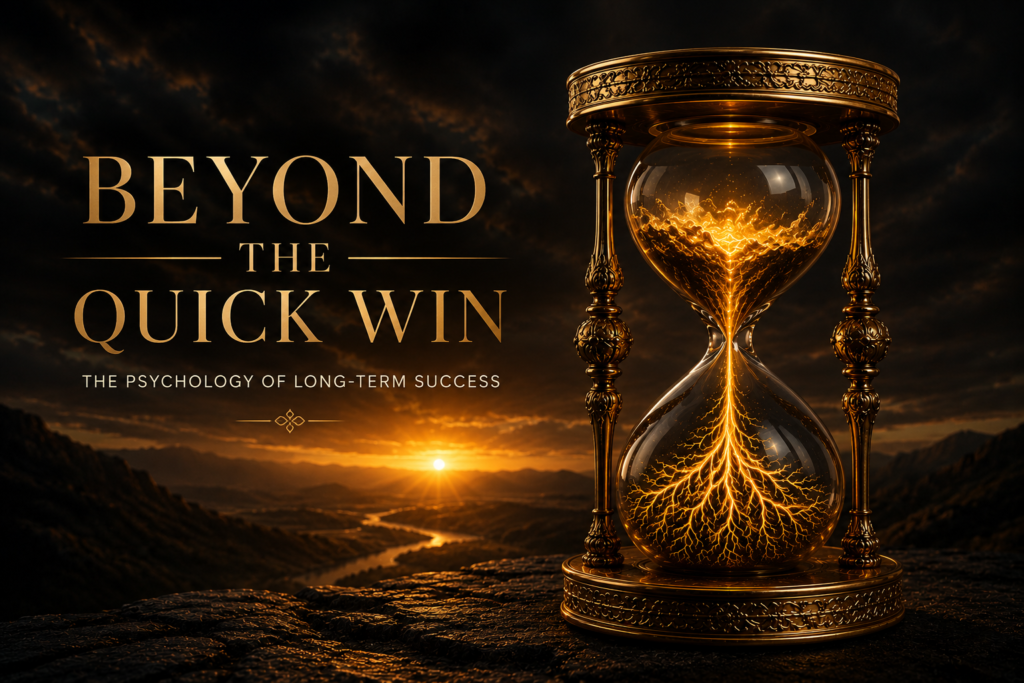
We live in a culture designed to eliminate waiting. If you want a meal, it arrives at your doorstep in thirty minutes. If you want a product, it will appear on your porch by tomorrow morning. If you want validation, you pull down on a screen and wait milliseconds for a stream of notifications.
Because our daily lives are so intensely automated for speed, we have developed a dangerous blind spot: we have forgotten that anything truly enduring—whether a profound intellectual legacy, a multi-generational family culture, or an impact that outlasts a lifetime—defies the laws of instant gratification.
At The Phenomenon Project, our focus is on decoding the deeper structural patterns that drive human excellence over centuries. When you look past the noise of temporary trends, you discover that the psychology of long-term success relies on a single, increasingly rare superpower: the ability to defer gratification in exchange for a larger, abstract future reward.
The Modern Trap of Hyper-Pragmatism
To understand why some groups and families sustain high achievement across generations while others fluctuate wildly, we have to look at how we view the purpose of effort.
Today, most educational and professional systems are deeply transactional. We encourage our children to learn a skill specifically so they can secure a job, which allows them to buy a house, which allows them to live comfortably. This is hyper-pragmatism. It views learning as a chore—a temporary tax you pay in your youth so you can enjoy your life later.
The problem with this model is that it has a low ceiling. Once basic security and comfort are achieved, the motivation evaporates. The momentum plateaus.
True generational endurance requires an entirely different psychological framework. Rather than viewing learning as a tool to achieve comfort, enduringly successful communities treat intellectual mastery and personal discipline as an identity. The goal is not to reach a point where you can finally stop working; the goal is to become an instrument of continuous growth. When a family shifts its culture from “what can we acquire?” to “who are we becoming?”, they build something incredibly resilient to economic and social shifts.
The Cognitive Vault: Generational Wealth vs. Cognitive Wealth
When people talk about building a legacy, they almost always mean a financial legacy. They think of real estate portfolios, stocks, or family businesses. But history teaches us that financial wealth is shockingly fragile. A sudden change in government policy, a severe economic depression, or even a single generation of reckless spending can wipe out centuries of accumulated capital.
This is why the world’s most resilient intellectual traditions prioritize cognitive wealth over material assets.
Cognitive wealth consists of internalized behavioral traits:
- The capacity for deep, uninterrupted focus.
- A natural comfort with abstract concepts.
- A household expectation of academic rigor.
- The emotional resilience required to handle failure without giving up.
Consider the historical trajectories of highly scholarly communities, such as those analyzed in Dr. Rahul Kashyap’s work, The Brahmin Phenomenon. Over centuries of political instability, formal privileges disappeared, and traditional systems shifted entirely. Yet, the demographic consistently adapted and thrived in modern, globalized knowledge economies—such as medicine, technology, and research.
Why? Because you cannot repossess a household culture. You cannot tax a habit of discipline out of existence. When your primary asset is hidden safely inside the minds of your children, your legacy becomes virtually bulletproof.
The Anatomy of Deferral: How It’s Built at Home
No one is born with a natural love for sitting at a desk for six hours, solving complex equations, or reading dense historical texts. Delayed gratification is not a genetic trait; it is a conditioned behavioral reflex.
In households that successfully master the psychology of long-term success, this conditioning is woven quietly into the fabric of daily life through three main pillars:
1. The Normalization of Waiting
In an environment optimized for the long game, children learn early that milestones are earned through prolonged preparation. The conversation around the dinner table isn’t focused on what can be enjoyed right now, but rather on the compounding value of what is being built for the decades ahead.
2. High Social Status for Intellectual Achievement
In general society, celebrity and financial extravagance are often worshiped. In legacy-driven cultures, the highest respect is reserved for the scholar, the researcher, and the master of a craft. When a child sees that their family values wisdom far more than material display, their internal ambition naturally recalibrates toward intellectual value.
3. The Classroom Without Walls
For these families, education doesn’t stop when the school bell rings. The home functions as a parallel academy where curiosity is actively rewarded, debates are normal, and books are considered essential infrastructure rather than luxury items.
Developing a Centuries-Long Perspective
The ultimate differentiator in the psychology of long-term success is the scale of time in which you choose to think.
The average person thinks in days or weeks. The corporate executive thinks in quarters. The politician thinks in election cycles. But to build a phenomenon, you must learn to think in generations.
When you look at your life through a multi-generational lens, your daily decisions change completely. You stop looking for shortcuts. You stop chasing the quick win or the temporary trend. You begin to understand that the quiet, unseen choices you make today—the discipline you maintain, the books you introduce to your household, the work ethic you display—are setting the invisible floor for people who will carry your name a hundred years from now.
Sustained excellence is never an accident. It is a choice to reject the immediate allure of the present in order to build a cathedral in the future.
Ready to explore the real-world frameworks behind cultural endurance? Read the inaugural book of this series, The Brahmin Phenomenon by Dr. Rahul Kashyap, for a deeply respectful, scientific breakdown of how internal household habits create lasting intellectual legacies.
Join us at The Phenomenon Project as we continue to decode the hidden blueprints of human behavior, history, and community resilience.